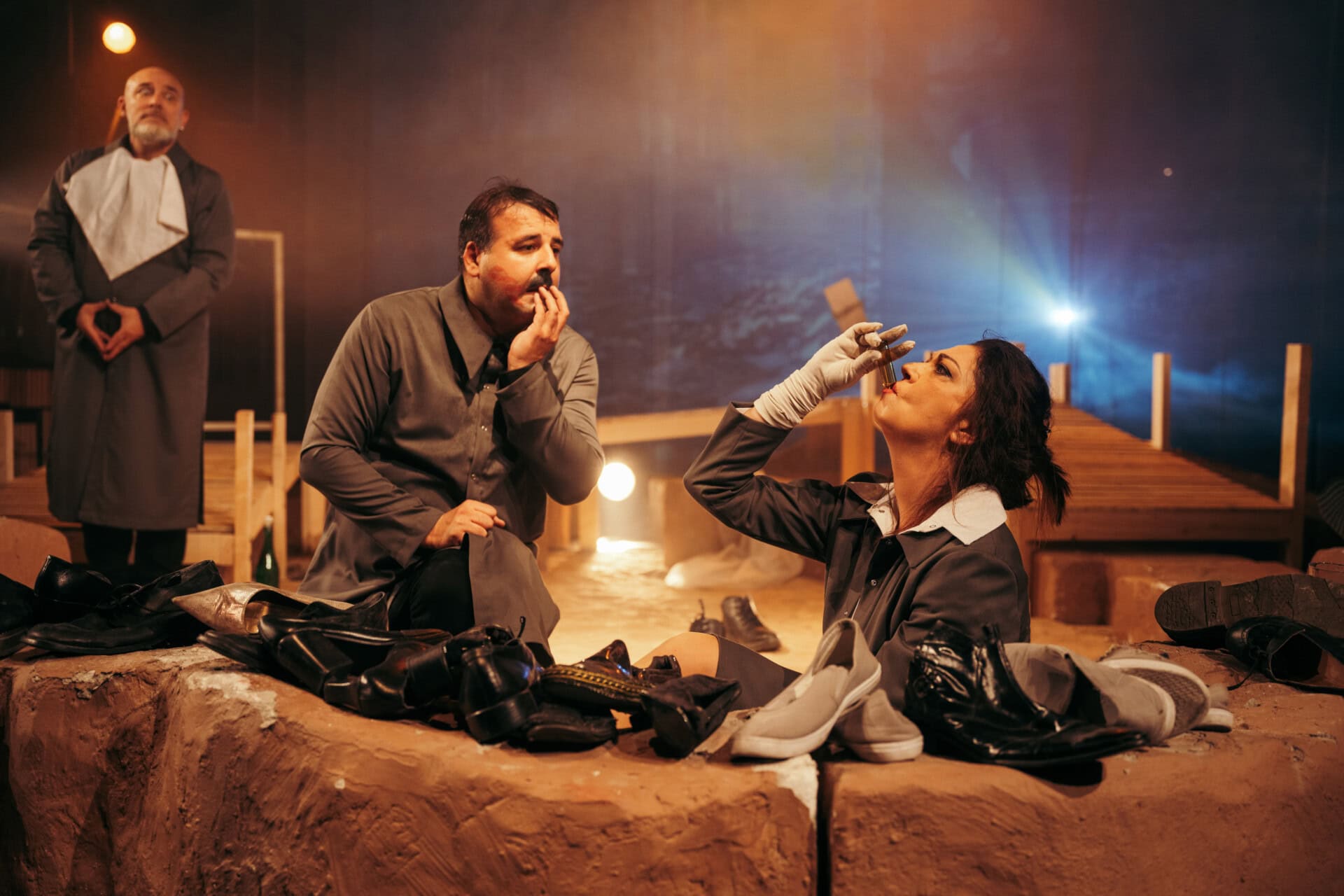


Is it worth giving your life for an idea, no matter how connected it is to national, patriotic, revolutionary or any other ideological honor? That is the central question posed by this unusual collage-drama, composed of six dramatic images from different historical eras in which an act of suicide took place. – writes Venko Andonovski.
Opening these questions already in the first scene, which deals with the famous heroic mass suicide committed by the Jews besieged in the legendary fortress of Masada, so that no one fell alive into the hands of the Romans, the drama begins with a recitation of ancient tragedies, and continues with a trivialization of the concept of the ancient sublime. A scene of mass suicide of a group of commies from Macedonian history follows, with all but one committing suicide in order not to fall alive into the hands of the Ottomans. The next scene is a collective suicide of Adolf Hitler, Eva Braun and his closest associates. As the scenes continue towards modern times, the decline of the ideal of heroic suicide and its trivialization is noticeable: today people kill themselves for women and money, but not for the nation, the state and the revolution. Even when terrorists hijack a plane in one scene, they are greeted by an unexpected story in which the victims are bigger terrorists than the hijackers themselves. In that sense, "The Fall of Masada" is a drama about the decline of morality and "sublime and heroic" values from ancient times to the present day, when everything is reduced to the trivialization of reality and values.


 English
  Macedonian