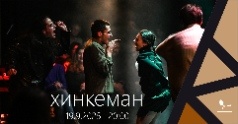
(Chamber performance)
The play "Hinkemann" is based on the anti-war and expressionist drama (Der deutsche Hinkemann, 1923) by Ernst Toler, whose greatest inspiration was the current historical context and the time in which he created it. The text attempts to convey the spiritual situation of the people and at the same time seeks justice and a better future in order to correct the distorted image of the society of the time. We recognize ourselves in Toler's text even today, and with that we should ask ourselves whether anything is changing at all in the depth of human behavior.
This text is a kind of exploration of the brutal forces that govern our world – the wars, social injustices, and ruthless systems of economic power that prey on the working class. "Hinkeman" is like a mirror of our society built on cruelty, money, and prejudice, and those who are different in any way, always, in any historical context, are ridiculed or rejected by the crowd.
Eugene Hinkeman, a war veteran who returns home physically and psychologically wounded, symbolizes the many who are abandoned by the system at the moment when they are no longer needed as a workforce and a means of earning a living. He is part of those who do not fit into the rigid rules of masculinity and pre-established stereotypes or societal expectations.
Humanity is accustomed to mocking the traumas of others, portraying them as symbols of failure. Victimization is followed by public humiliation, and Hinkeman, rejected by society and forced to work as a circus "freak" in so-called freak shows, becomes a symbol of how the world treats its most vulnerable people - turning their suffering into a spectacle for entertainment.
The play shows how deep-rooted prejudices and fear of the unknown create a culture of bullying and harassment, where society mistreats those who deviate from the norm – whether due to physical appearance, gender roles, or any other perceived difference. The play is also a profound critique of war and its endless, cyclical violence. War is not just a distant memory or a moment in history – it is ever-present and is no longer seen as a temporary event, but a constant, inevitable part of our society that “progresses” through division, exploitation and control. This way of life dehumanizes us all, conditioning us to accept violence as a permanent place in our world.
Hinkeman encourages us to see the world through the eyes of those who are marginalized and discriminated against, and delivers a message of understanding, empathy, and togetherness. Through his journey, we are reminded that every individual, no matter how broken or different, deserves dignity and compassion.This is a call to build a society that helps people instead of pushing them to the margins – a society where empathy is a source of strength, transforming not only individuals but also the world around us.
Author: Ernst Toler
Director and Adaptation: Tamara Stojanoska
Translation and Author's Text: Tamara Stojanoska and Boban Aleksoski
Music: Luka Toshev
Poster and Advertising Material Designer: Bojana Cilevska
Scenography: Tamara Stojanoska
Costume Selection: Tamara Stojanoska in consultation with Vesna Mihajlovska
Lighting design: Tamara Stojanoska in consultation with Sasho Todorovski – Šture
Official photo and video: Tamara Malkoska
Photos MOT 2024: Aleksandar Ristovski
Premiere: November 15, 2024, 49th IWF, Youth Cultural Center
"Zlaten Elets" Theater in co-production with Young Open Theater and Youth Cultural Center Skopje
Playing:
Boban Aleksoski
Talija Nastova / Nadica Petrova
Driton Vejseli / Filip Hristovski
Ane Blazhovski
Leonida Gulevska
Branko Mihajloski
Information and reservations at 076/434343



 English
  Macedonian